
Resolving Land-Use Disputes: Boundaries, Routes, and Resource Damage
In many rural and semi-rural communities, land is not just a physical space; it is the foundation of livelihoods, identity, and survival. When boundaries are unclear, grazing routes are blocked, or crops and pasture are damaged, people often feel that their way of life is under threat. What may appear to be a simple disagreement over land use can quickly escalate into anger, fear, and mistrust, especially when people already face pressure from climate change, population growth, or shrinking resources.
These disputes rarely happen because people want to harm one another. More often, they arise because expectations are different, agreements are not clearly understood, or changing conditions force people to make difficult choices. When such tensions are ignored or handled solely through blame and punishment, they tend to resurface and grow stronger. Communities then find themselves caught in cycles of accusation, retaliation, and violence that damage relationships and weaken social cohesion.
This section focuses on ways communities can resolve land-use disputes in a fair, transparent, and respectful manner for everyone involved. It emphasises joint fact-finding, open dialogue, and community-agreed standards for assessing damage and determining responsibility. Rather than asking who should win, the approaches here ask how harm can be repaired, trust rebuilt, and future conflict prevented. By centring people’s experiences and needs, these processes help communities move beyond confrontation and toward cooperation, ensuring that land remains a source of life rather than division.
This section offers practical recommendations for preventing and resolving land conflicts, grazing route disputes, water access issues, and crop/pasture damage between farmers and herders. These clear guidelines aim to reduce tension, restore trust, and support peaceful coexistence and livelihoods.
The recommendations are based on extensive qualitative research in Benue State, including 65 Key Informant Interviews (KIIs) with justice and conflict-resolution actors and Focus Group Discussions (FGDs) with 12 community participants. Respondents included leaders, mediators, security actors, and officials.
Following the recommendations are the best practices that informed them, reflecting real-life experiences of communities and mediators managing disputes and preventing violence in local and comparable settings.
This section serves as a shared reference for community and traditional leaders, representatives of pastoralists and farmers, mediators, paralegals, religious leaders, local authorities, civil society organisations, and development practitioners seeking fair, respectful, and people-centred dispute resolution.
A. Resolve Boundary and Route Disputes Through Joint Delineation
Joint delineation is a collaborative process where farmers, herders, and community representatives come together to identify, clarify, and agree on disputed boundaries and routes. Rather than relying on one-sided claims, this approach allows all parties to contribute their knowledge and reach a shared understanding of where land and pathways lie.
Practitioners should facilitate joint delineation processes to resolve disputes over farm boundaries, grazing routes, corridors, and access paths. These processes should involve the affected parties, elders, traditional leaders, women, youth, and neighbouring communities where relevant. Joint identification of contested areas and historical use patterns reduces mistrust, corrects misunderstandings, and replaces confrontation with shared understanding.
Joint delineation should begin with dialogue, followed by joint visits to the disputed site and participatory mapping using local landmarks. All parties should have the opportunity to explain their perspectives and propose adjustments. Once agreement is reached, the delineation should be publicly validated and recorded through maps, physical markers, or community testimony and referenced in future mediation or land-use planning. By seeing and agreeing together, communities transform contested claims into shared reference points that support lasting peace.
'/%3e%3cdefs%3e%3clinearGradient%20id='paint0_linear_465_86477'%20x1='15.9997'%20y1='2'%20x2='15.9997'%20y2='28.9957'%20gradientUnits='userSpaceOnUse'%3e%3cstop%20stop-color='%2317D571'/%3e%3cstop%20offset='1'%20stop-color='%23166C3F'/%3e%3c/linearGradient%3e%3c/defs%3e%3c/svg%3e)
Strongly Recommended
B. Apply the conflict onion model to identify the interests behind a position and ultimately uncover the underlying needs, fears, and desires.
The Onion Model is a simple conflict analysis tool that helps people look beyond visible demands to understand the deeper reasons behind a dispute. It distinguishes between positions (what people say they want), interests (why they want it), and needs (the deeper concerns that must be met for people to feel secure and respected).
Practitioners should use the Onion Model to guide dialogue between farmers and herders during disputes over land, routes, or resource damage. By helping each party move beyond fixed positions and explore their underlying interests and needs, the Onion Model creates space for empathy, reduces hostility, and supports the development of solutions that address what truly matters to everyone involved.
During mediation, facilitators should encourage each party first to express their position, then gently ask why the issue matters to them and what they fear losing. These conversations can reveal shared needs such as livelihood security, safety, dignity, and belonging, even when positions appear opposed. By focusing on these deeper layers, communities can identify options that satisfy both sides, making agreements more realistic, respectful, and lasting.
Strongly Recommended
C. Use the conflict-tree to enhance respect and understanding.
The Conflict Tree is a simple visual tool that helps farmers and herders understand how visible disputes over land, routes, cattle rustling, or crop damage grow from deeper, shared problems. It shows that what people see on the surface, such as quarrels, threats, or violence, are the branches of a conflict. At the same time, the real causes lie beneath in the roots, including water scarcity, unclear agreements, fear, or lack of communication.
Practitioners should use the Conflict Tree during dialogue and mediation processes to help farmers and herders explore the underlying causes and impacts of their disputes. By encouraging both sides to reflect on what lies beneath the conflict, the tool shifts the conversation away from blame and toward shared understanding. This process supports empathy, reduces hostility, and creates space for solutions that address the real sources of tension.
During community dialogue or mediation, facilitators can draw a simple tree and guide participants to describe the main problem, its root causes, and its effects on people’s lives. As farmers and herders recognise that many of the roots and impacts are shared, they begin to see one another not as enemies but as partners facing similar challenges. The Conflict Tree then serves as a foundation for identifying joint actions, such as reopening routes, improving communication, or revising agreements, to prevent future disputes and strengthen relationships.
Strongly Recommended
D. Conduct Transparent Crop Damage and Cattle Rustling Assessment
Transparent crop damage and cattle rustling assessment is a collaborative, open process for determining what was damaged, how it occurred, and how it has affected the farmer or herder. It helps replace suspicion and blame with shared facts, so that decisions about compensation or repair are seen as fair.
Practitioners should support farmers, herders, and trusted community representatives in jointly assessing crop or pasture damage, using clear, commonly agreed criteria. Both sides should be present and heard, and neutral community members should be involved to ensure fairness. Transparency in the assessment process builds trust and reduces the risk of retaliation.
Assessments should be carried out as soon as possible through a joint visit to the affected area. The group should agree on what was damaged, the extent of the damage, and the likely causes, taking into account crop type, growth stage, and the affected area. Findings should be shared openly and recorded in simple ways, oral, written, or visual, so that they can guide dialogue, compensation, and future prevention efforts.
Strongly Recommended
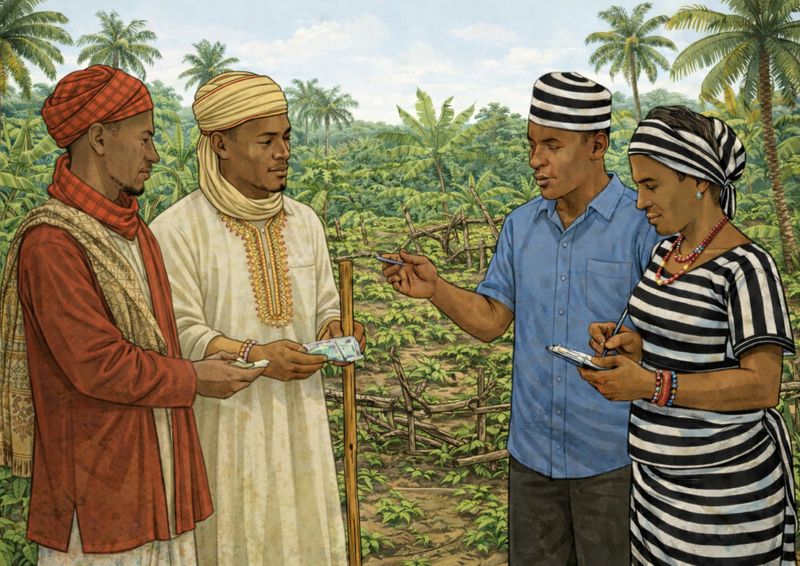
E. Agree on Fair Ways to Compensate for Loss and Damage
This refers to community-agreed processes for deciding how harm caused by crop damage, pasture loss, blocked routes, or other land-use incidents is repaired in ways that are fair, respectful, and restorative. The goal is not punishment, but to restore livelihoods, dignity, and trust between farmers and herders. Practitioners should support farmers, herders, and community leaders in jointly agreeing on clear, fair ways to assess damage and determine appropriate compensation. These agreements should be based on community-accepted criteria, reflect local realities, and ensure that compensation is proportionate, timely, and focused on restoring relationships rather than assigning blame.
Community leaders, mediators, and practitioners should openly discuss and agree on what counts as damage, how its value is determined, and what forms of compensation are acceptable, whether in cash, labour, produce, fodder, or other in-kind support. These agreements should be publicly acknowledged and used as reference points during mediation. When applied consistently, they reduce arguments, prevent retaliation, and help communities move forward after harm has occurred.
Strongly Recommended
Best Practices on Joint Boundary Verification Through Physical Inspection
- Boundary and route disputes should be resolved through a joint on-site verification process. Traditional leaders, elders, and representatives of both farmers and herders visit the disputed location together to observe the land directly and clarify farm boundaries, cattle routes, and any encroachment. Practitioners should ensure that inspection teams include neutral community figures, relevant women or youth representatives, and at least one knowledgeable farmer and herder. Findings are discussed on-site in simple, shared language, and a consensus is reached and recorded immediately to prevent later misunderstanding or reinterpretation. In line with literature research
- In Benue State, damage to crops, water points, or fences is assessed through a community-based valuation process led by trusted local assessors, such as experienced farmers, forest guards, or peace committee members who understand seasonal yields and local costs. Practitioners should support the formation of small, trained assessment teams that estimate losses transparently, taking into account crop stage, market value, and the extent of damage. Findings should be explained openly to both parties, ensuring that compensation decisions are evidence-based, locally credible, and widely accepted. Other practice
- Practitioners should guide mediators to frame discussions around questions such as: What will restore the farmer or herder's livelihood? What can the farmer or the herder realistically provide? This restorative lens reduces bitterness and encourages voluntary compliance. In line with literature research
- Disputes are resolved through a community-first, staged procedure that begins with dialogue and joint site inspection, proceeds to local negotiation and review by higher traditional authorities if needed, and refers cases to formal institutions only as a last resort, using local assessors, open witnessed resolutions, and compensation framed as repair to preserve trust and long-term coexistence. Other practice